Bookmaker Margin and Overround: How Betting Prices Add Up
Learn how to convert odds into implied probability and estimate the bookmaker margin built into a betting market.
Learn how to convert odds into implied probability and estimate the bookmaker margin built into a betting market.
This expanded guide is written for adult readers who want a documented way to assess bookmaker margin and overround: how betting prices add up. It explains the underlying concept, shows how to check the relevant evidence, works through a realistic example and identifies the mistakes that most often distort a decision. It does not promise profit, remove variance or replace local legal, financial or professional advice.
Convert each price to probability
Decimal odds can be converted with one divided by the odds. For example, 2.00 implies 50 percent before adjusting for margin. Repeat the calculation for every possible outcome.
Sports-betting odds are prices for uncertain outcomes, not predictions or promises. A professional review separates market rules, implied probability, bookmaker margin and personal risk controls. It also records the exact price and settlement wording because both can change before an event begins. In this part of the review, the practical question is whether the available evidence supports the claim about convert each price to probability. Record the source, the exact wording and the date checked. That record makes later comparison possible and prevents a marketing summary from replacing the underlying rule.
Add the probabilities
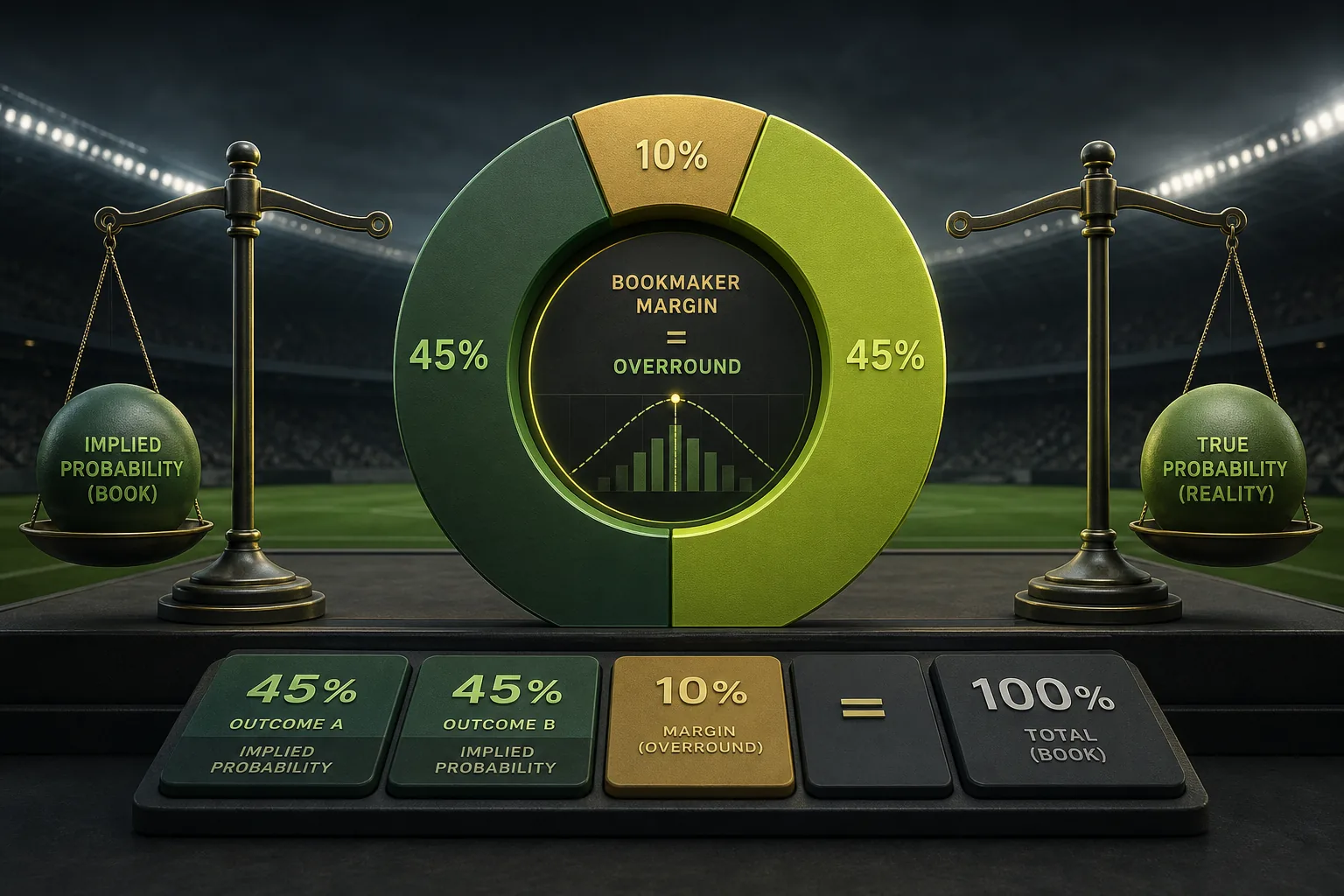
A fair market totals 100 percent. A bookmaker market normally totals more; that excess is commonly called overround. In a two-outcome market where both sides imply 52.5 percent, the total is 105 percent and the simple overround is five percentage points.
Sports-betting odds are prices for uncertain outcomes, not predictions or promises. A professional review separates market rules, implied probability, bookmaker margin and personal risk controls. It also records the exact price and settlement wording because both can change before an event begins. In this part of the review, the practical question is whether the available evidence supports the claim about add the probabilities. Record the source, the exact wording and the date checked. That record makes later comparison possible and prevents a marketing summary from replacing the underlying rule.
Use margin as a comparison tool
Lower overround can mean a more competitive price, but settlement rules, limits and account safety still matter. Compare the same market at the same moment because prices move.
Sports-betting odds are prices for uncertain outcomes, not predictions or promises. A professional review separates market rules, implied probability, bookmaker margin and personal risk controls. It also records the exact price and settlement wording because both can change before an event begins. In this part of the review, the practical question is whether the available evidence supports the claim about use margin as a comparison tool. Record the source, the exact wording and the date checked. That record makes later comparison possible and prevents a marketing summary from replacing the underlying rule.
A professional review method
A reliable assessment should be repeatable by another reader. Start with the exact decision, collect primary evidence before commentary, convert numbers into a comparable form and document anything that remains uncertain. The following steps turn a broad topic into a practical review that can be checked later.
- Step 1: Use all possible outcomes. Locate the exact record, term, figure or rule that answers this point. Save where it appeared and when it was checked, then compare it with the claim made on the main page. If the two sources disagree, pause the decision and use the formal support or complaint route instead of guessing.
- Step 2: Compare like-for-like markets. Locate the exact record, term, figure or rule that answers this point. Save where it appeared and when it was checked, then compare it with the claim made on the main page. If the two sources disagree, pause the decision and use the formal support or complaint route instead of guessing.
- Step 3: Record prices at the same time. Locate the exact record, term, figure or rule that answers this point. Save where it appeared and when it was checked, then compare it with the claim made on the main page. If the two sources disagree, pause the decision and use the formal support or complaint route instead of guessing.
- Step 4: Do not confuse lower margin with certainty. Locate the exact record, term, figure or rule that answers this point. Save where it appeared and when it was checked, then compare it with the claim made on the main page. If the two sources disagree, pause the decision and use the formal support or complaint route instead of guessing.
- Final step: test the conclusion. Write the strongest reason your conclusion could be wrong. Check that alternative against the same evidence and state any limitation clearly. A professional answer can be cautious or incomplete; it should not hide uncertainty behind a confident score.
Worked example
Consider a two-outcome market priced at 1.91 on each side. Dividing one by 1.91 gives an implied probability of about 52.36 percent per outcome. Together they total roughly 104.72 percent, so the simple overround is about 4.72 percentage points. The calculation describes the price structure; it does not reveal which outcome will occur.
The example is useful because it separates a headline from the sequence that produces a real outcome. Change one input at a time and recalculate: the legal scope, price, stake, contribution, fee, time window or verification status may materially change the answer. Keep the arithmetic and the evidence together so that the conclusion can be reviewed without relying on memory.
Common mistakes and warning signs
Most errors in this area come from skipping a definition, comparing unlike information or letting urgency replace verification. The following warning signs do not all prove misconduct, but each one is a reason to stop and obtain clearer evidence before proceeding.
- Adding odds instead of adding implied probabilities. This removes an important control from the decision. Return to the primary record, restate the question in plain language and document the answer. If the information is not published or support cannot explain it consistently, treat the uncertainty as a negative signal.
- Calling overround the bookmaker's guaranteed realised profit. This removes an important control from the decision. Return to the primary record, restate the question in plain language and document the answer. If the information is not published or support cannot explain it consistently, treat the uncertainty as a negative signal.
- Comparing different lines or timestamps. This removes an important control from the decision. Return to the primary record, restate the question in plain language and document the answer. If the information is not published or support cannot explain it consistently, treat the uncertainty as a negative signal.
- Ignoring three-way outcomes such as a draw. This removes an important control from the decision. Return to the primary record, restate the question in plain language and document the answer. If the information is not published or support cannot explain it consistently, treat the uncertainty as a negative signal.
Deeper analysis: what the headline misses
Overround is most useful for like-for-like comparison. Markets move, and an apparently lower margin can be attached to different settlement rules, limits or liquidity. More advanced methods allocate margin unevenly rather than assuming the same adjustment on every selection. For a beginner, calculating the simple total is still a valuable way to see that displayed probabilities normally exceed 100 percent.
Sports-betting odds are prices for uncertain outcomes, not predictions or promises. A professional review separates market rules, implied probability, bookmaker margin and personal risk controls. It also records the exact price and settlement wording because both can change before an event begins. Professional analysis also separates what is known from what is inferred. A published rule can establish a requirement; it cannot establish that every operator follows it in every case. A calculation can describe cost or probability; it cannot predict one result. That distinction keeps the guide useful without overstating certainty.
Decision framework
Use the table as a final quality check. A strong conclusion has evidence in every row. One missing item may justify more research; several missing items usually mean the decision should be postponed.
| Question | Evidence to record |
|---|---|
| Use all possible outcomes | The exact source, value or wording; the applicable scope; the date checked; and any unresolved contradiction. |
| Compare like-for-like markets | The exact source, value or wording; the applicable scope; the date checked; and any unresolved contradiction. |
| Record prices at the same time | The exact source, value or wording; the applicable scope; the date checked; and any unresolved contradiction. |
| Do not confuse lower margin with certainty | The exact source, value or wording; the applicable scope; the date checked; and any unresolved contradiction. |
Quick verification checklist
- Use all possible outcomes
- Compare like-for-like markets
- Record prices at the same time
- Do not confuse lower margin with certainty
Related Gamblingr guides
Frequently asked questions
Is overround the bookmaker’s guaranteed profit?
No. It is a pricing measure; actual results and customer activity vary.
Can one outcome have good value in a high-margin market?
Possibly, but value requires a sound probability estimate, not just a large price.
How should a reader approach "Convert each price to probability"?
Decimal odds can be converted with one divided by the odds. For example, 2.00 implies 50 percent before adjusting for margin. Repeat the calculation for every possible outcome.
How should a reader approach "Add the probabilities"?
A fair market totals 100 percent. A bookmaker market normally totals more; that excess is commonly called overround. In a two-outcome market where both sides imply 52.5 percent, the total is 105 percent and the simple overround is five percentage points.
How should a reader approach "Use margin as a comparison tool"?
Lower overround can mean a more competitive price, but settlement rules, limits and account safety still matter. Compare the same market at the same moment because prices move.
What should be recorded for "Use all possible outcomes" in Bookmaker Margin and Overround: How Betting Prices Add Up?
Record the exact source and wording for use all possible outcomes, the scope in which it applies, the date checked and any contradiction that still needs clarification.
What should be recorded for "Compare like-for-like markets" in Bookmaker Margin and Overround: How Betting Prices Add Up?
Record the exact source and wording for compare like-for-like markets, the scope in which it applies, the date checked and any contradiction that still needs clarification.
Why is "Adding odds instead of adding implied probabilities" a warning sign?
Adding odds instead of adding implied probabilities removes an important verification step. Return to the primary record, compare the claim with the published rule and pause if the evidence remains unclear.
Final assessment
Bookmaker Margin and Overround: How Betting Prices Add Up is best approached as a documented decision rather than a quick yes-or-no claim. Verify the source, calculate the practical effect, check the scope and keep a stop condition. When the evidence is incomplete, the professional response is to wait. When gambling no longer feels optional, affordable or controllable, stop and use stronger safeguards or confidential support.
Editorial note: Gamblingr publishes educational information for adults. Rules and product terms can change, so primary sources were checked where available and should be verified again before a decision.
Leave a Reply