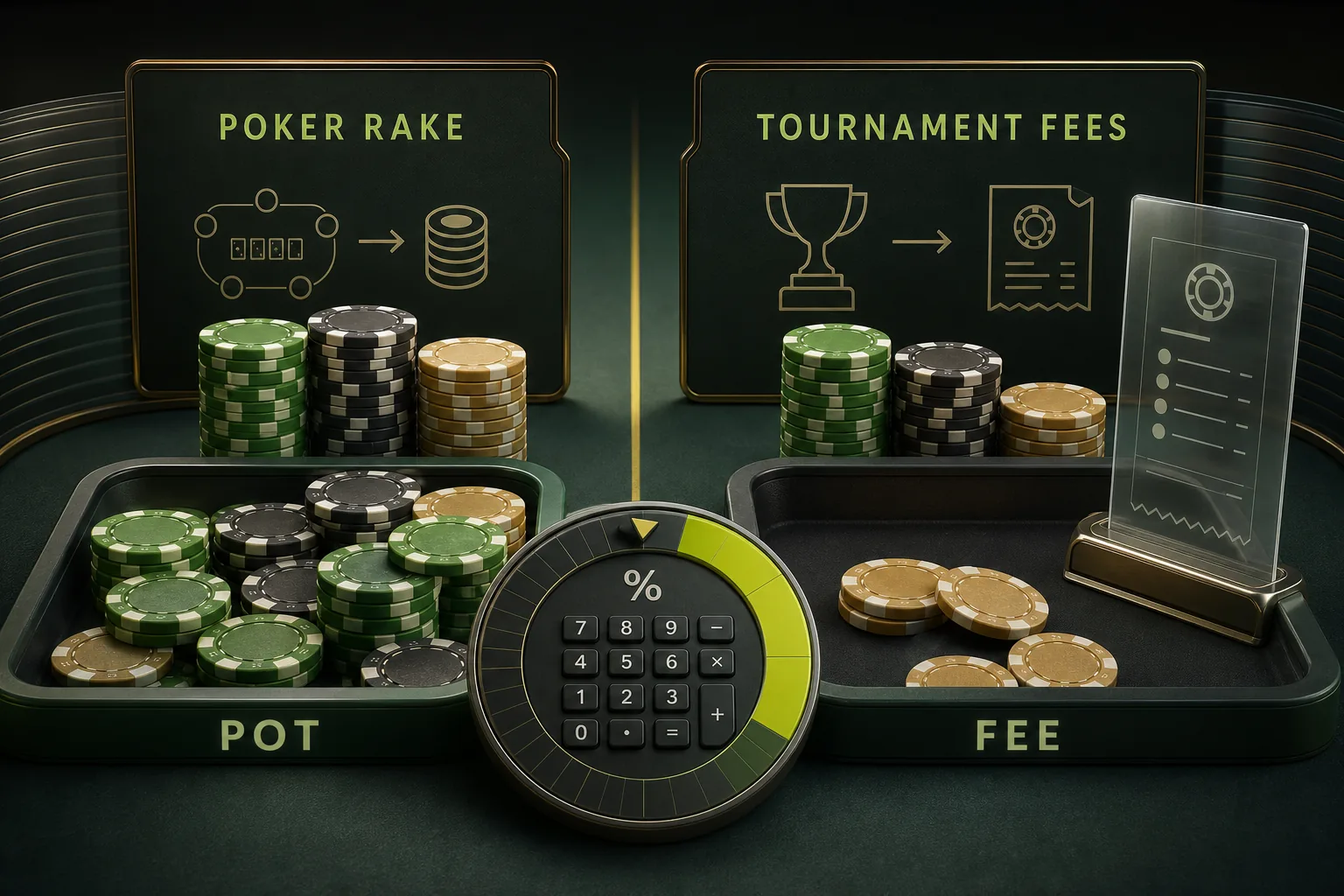
Poker Rake and Tournament Fees: The Cost of Playing
Compare cash-game rake, time charges and tournament fees so you can estimate the real cost of a poker session.
Compare cash-game rake, time charges and tournament fees so you can estimate the real cost of a poker session.
This expanded guide is written for adult readers who want a documented way to assess poker rake and tournament fees: the cost of playing. It explains the underlying concept, shows how to check the relevant evidence, works through a realistic example and identifies the mistakes that most often distort a decision. It does not promise profit, remove variance or replace local legal, financial or professional advice.
Cash-game rake comes from pots
Rooms may take a percentage up to a cap, use a fixed drop or charge time. Small pots and short-handed games can be affected differently, so compare the full schedule at the stakes you play.
Poker combines decisions, incomplete information, variance and unavoidable fees. A good framework therefore evaluates both strategy and the cost of participation. Short-term results can be noisy, so readers should judge a process by documented decisions and risk controls rather than by one winning or losing session. In this part of the review, the practical question is whether the available evidence supports the claim about cash-game rake comes from pots. Record the source, the exact wording and the date checked. That record makes later comparison possible and prevents a marketing summary from replacing the underlying rule.
Tournament fees are shown in the buy-in
A listing such as 100 plus 10 sends 100 to the prize pool and 10 to the operator. Re-entries, add-ons and service charges can increase the total session cost.
Poker combines decisions, incomplete information, variance and unavoidable fees. A good framework therefore evaluates both strategy and the cost of participation. Short-term results can be noisy, so readers should judge a process by documented decisions and risk controls rather than by one winning or losing session. In this part of the review, the practical question is whether the available evidence supports the claim about tournament fees are shown in the buy-in. Record the source, the exact wording and the date checked. That record makes later comparison possible and prevents a marketing summary from replacing the underlying rule.
Rewards should not hide the base price
Loyalty points or rakeback may return part of the fee, but eligibility, volume and expiry matter. Compare net cost without assuming rewards are guaranteed.
Poker combines decisions, incomplete information, variance and unavoidable fees. A good framework therefore evaluates both strategy and the cost of participation. Short-term results can be noisy, so readers should judge a process by documented decisions and risk controls rather than by one winning or losing session. In this part of the review, the practical question is whether the available evidence supports the claim about rewards should not hide the base price. Record the source, the exact wording and the date checked. That record makes later comparison possible and prevents a marketing summary from replacing the underlying rule.
A professional review method
A reliable assessment should be repeatable by another reader. Start with the exact decision, collect primary evidence before commentary, convert numbers into a comparable form and document anything that remains uncertain. The following steps turn a broad topic into a practical review that can be checked later.
- Step 1: Percentage and cap. Locate the exact record, term, figure or rule that answers this point. Save where it appeared and when it was checked, then compare it with the claim made on the main page. If the two sources disagree, pause the decision and use the formal support or complaint route instead of guessing.
- Step 2: No-flop-no-drop rule. Locate the exact record, term, figure or rule that answers this point. Save where it appeared and when it was checked, then compare it with the claim made on the main page. If the two sources disagree, pause the decision and use the formal support or complaint route instead of guessing.
- Step 3: Tournament fee component. Locate the exact record, term, figure or rule that answers this point. Save where it appeared and when it was checked, then compare it with the claim made on the main page. If the two sources disagree, pause the decision and use the formal support or complaint route instead of guessing.
- Step 4: Reward exclusions. Locate the exact record, term, figure or rule that answers this point. Save where it appeared and when it was checked, then compare it with the claim made on the main page. If the two sources disagree, pause the decision and use the formal support or complaint route instead of guessing.
- Final step: test the conclusion. Write the strongest reason your conclusion could be wrong. Check that alternative against the same evidence and state any limitation clearly. A professional answer can be cautious or incomplete; it should not hide uncertainty behind a confident score.
Worked example
A tournament listed as 100+10 sends 100 to the prize pool and 10 to the operator, creating a 9.09 percent fee relative to the total 110 paid. A cash game may instead take five percent of qualifying pots up to a cap. The cheaper option cannot be identified from percentages alone; frequency, cap, field, stakes and session length all matter.
The example is useful because it separates a headline from the sequence that produces a real outcome. Change one input at a time and recalculate: the legal scope, price, stake, contribution, fee, time window or verification status may materially change the answer. Keep the arithmetic and the evidence together so that the conclusion can be reviewed without relying on memory.
Common mistakes and warning signs
Most errors in this area come from skipping a definition, comparing unlike information or letting urgency replace verification. The following warning signs do not all prove misconduct, but each one is a reason to stop and obtain clearer evidence before proceeding.
- Comparing rake percentages without the cap. This removes an important control from the decision. Return to the primary record, restate the question in plain language and document the answer. If the information is not published or support cannot explain it consistently, treat the uncertainty as a negative signal.
- Ignoring fixed drops in small pots. This removes an important control from the decision. Return to the primary record, restate the question in plain language and document the answer. If the information is not published or support cannot explain it consistently, treat the uncertainty as a negative signal.
- Treating tournament chips as part of the operator fee. This removes an important control from the decision. Return to the primary record, restate the question in plain language and document the answer. If the information is not published or support cannot explain it consistently, treat the uncertainty as a negative signal.
- Counting rewards before checking qualification and expiry. This removes an important control from the decision. Return to the primary record, restate the question in plain language and document the answer. If the information is not published or support cannot explain it consistently, treat the uncertainty as a negative signal.
Deeper analysis: what the headline misses
Fees are part of poker performance. Two players can make identical table decisions and finish with different net results because their rake, time charge or tournament fee differs. Rewards can return some cost but introduce volume, tier and expiry conditions. A professional comparison begins with the base fee schedule, estimates cost at the relevant stakes and treats rewards as a separate adjustment.
Poker combines decisions, incomplete information, variance and unavoidable fees. A good framework therefore evaluates both strategy and the cost of participation. Short-term results can be noisy, so readers should judge a process by documented decisions and risk controls rather than by one winning or losing session. Professional analysis also separates what is known from what is inferred. A published rule can establish a requirement; it cannot establish that every operator follows it in every case. A calculation can describe cost or probability; it cannot predict one result. That distinction keeps the guide useful without overstating certainty.
Decision framework
Use the table as a final quality check. A strong conclusion has evidence in every row. One missing item may justify more research; several missing items usually mean the decision should be postponed.
| Question | Evidence to record |
|---|---|
| Percentage and cap | The exact source, value or wording; the applicable scope; the date checked; and any unresolved contradiction. |
| No-flop-no-drop rule | The exact source, value or wording; the applicable scope; the date checked; and any unresolved contradiction. |
| Tournament fee component | The exact source, value or wording; the applicable scope; the date checked; and any unresolved contradiction. |
| Reward exclusions | The exact source, value or wording; the applicable scope; the date checked; and any unresolved contradiction. |
Quick verification checklist
- Percentage and cap
- No-flop-no-drop rule
- Tournament fee component
- Reward exclusions
Related Gamblingr guides
Frequently asked questions
Is lower rake always the best room?
Safety, liquidity, game quality and withdrawal reliability also matter.
Does rake affect winning players?
Yes. Fees reduce every player’s net result over time.
How should a reader approach "Cash-game rake comes from pots"?
Rooms may take a percentage up to a cap, use a fixed drop or charge time. Small pots and short-handed games can be affected differently, so compare the full schedule at the stakes you play.
How should a reader approach "Tournament fees are shown in the buy-in"?
A listing such as 100 plus 10 sends 100 to the prize pool and 10 to the operator. Re-entries, add-ons and service charges can increase the total session cost.
How should a reader approach "Rewards should not hide the base price"?
Loyalty points or rakeback may return part of the fee, but eligibility, volume and expiry matter. Compare net cost without assuming rewards are guaranteed.
What should be recorded for "Percentage and cap" in Poker Rake and Tournament Fees: The Cost of Playing?
Record the exact source and wording for percentage and cap, the scope in which it applies, the date checked and any contradiction that still needs clarification.
What should be recorded for "No-flop-no-drop rule" in Poker Rake and Tournament Fees: The Cost of Playing?
Record the exact source and wording for no-flop-no-drop rule, the scope in which it applies, the date checked and any contradiction that still needs clarification.
Why is "Comparing rake percentages without the cap" a warning sign?
Comparing rake percentages without the cap removes an important verification step. Return to the primary record, compare the claim with the published rule and pause if the evidence remains unclear.
Final assessment
Poker Rake and Tournament Fees: The Cost of Playing is best approached as a documented decision rather than a quick yes-or-no claim. Verify the source, calculate the practical effect, check the scope and keep a stop condition. When the evidence is incomplete, the professional response is to wait. When gambling no longer feels optional, affordable or controllable, stop and use stronger safeguards or confidential support.
Editorial note: Gamblingr publishes educational information for adults. Rules and product terms can change, so primary sources were checked where available and should be verified again before a decision.
Leave a Reply